
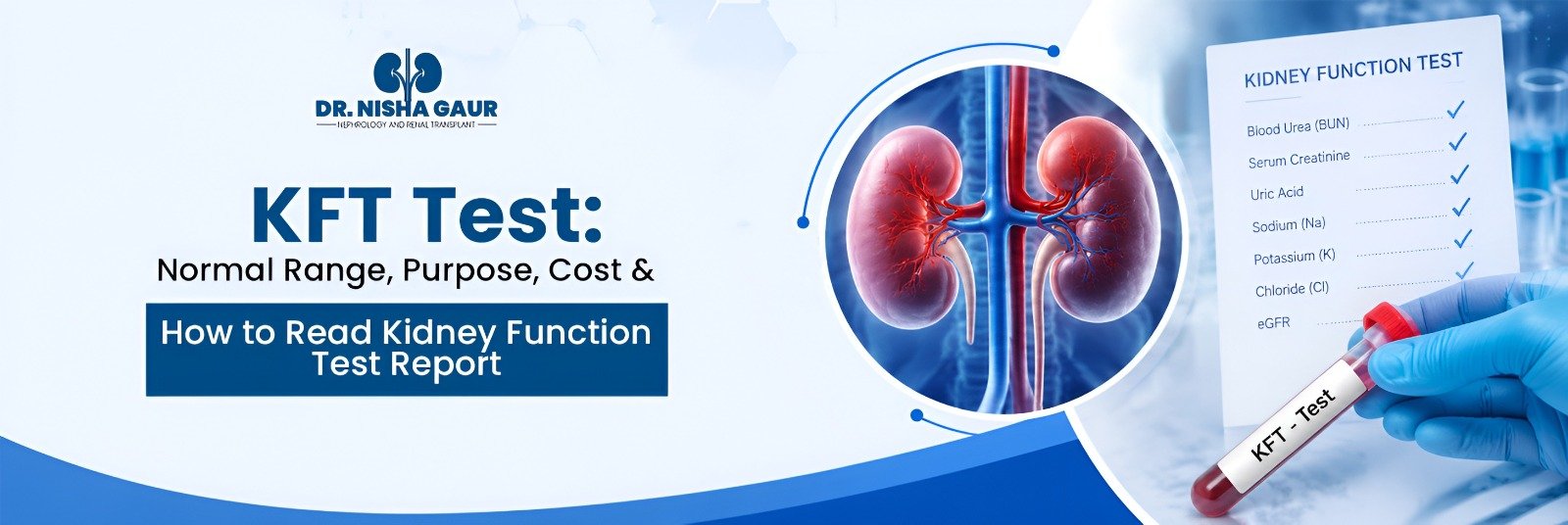
A KFT, or Kidney Function Test, is a series of tests done to find out how effectively the kidneys are operating. It measures renal filtration, waste levels in the blood, and electrolyte balance. The assessment involves reviewing data common to this process, such as creatinine, urea or BUN, uric acid, eGFR, sodium, potassium, and urine albumin.
These measurements can be used to diagnose early renal stress, to follow ongoing disease and to guide treatment options. If your KFT data shows abnormal creatinine, low eGFR or protein in urine, then consult the best nephrologist in Jaipur for the appropriate diagnosis.
What Is a KFT Test?
KFT full form is Kidney Function Test. In many labs, the same test panel may also be called RFT, Renal Function Test, or simply a kidney panel.
- A KFT includes blood tests and, in some cases, urine tests. Together, these investigations show how effectively the kidneys filter waste from the blood.
- The kidneys also contribute to blood pressure regulation. Kidney function tests help determine how efficiently the kidneys clear waste from the bloodstream.
Why Is a Kidney Function Test Done?
A kidney problem does not always begin with obvious symptoms. In many people, the earliest changes appear in test reports before they cause pain, swelling, or a visible decline in health.
That is why a KFT is often used both as a screening test and as a monitoring tool. It helps doctors identify silent kidney damage, measure the severity of an existing problem, and follow the response to treatment over time.
To Detect Kidney Disease Early
Early detection is a key reason to do a KFT. Kidney deterioration can be delayed, particularly in patients with previous problems with blood vessels or the filtering system.
- In the presence of clinical features such as swelling of the limbs or hypertension, the doctor may order this test.
- In such cases, an abnormal creatinine level, a low eGFR or protein loss in urine could be an early warning sign.
To Monitor Existing Kidney Problems
If a patient already has chronic kidney disease, kidney infection, kidney stones, or protein loss in urine, a KFT helps track the condition.
- It shows whether kidney function is stable, whether the disease is progressing, or whether treatment needs to be adjusted.
- Serial reports are often more useful than a single isolated value. A doctor may compare present values with earlier ones to understand the overall trend.
Before Surgery or Certain Medicines
Some medicines can affect kidney function. This is especially relevant with long-term painkiller use, certain antibiotics, contrast dye used in imaging, and some treatments for chronic illness.
- For this reason, doctors may advise a KFT before surgery or before starting medicines that can strain the kidneys.
- A pre-treatment KFT provides a baseline and helps reduce avoidable complications.
For Diabetes and Hypertension Patients
People with diabetes and hypertension have a significantly higher risk of kidney damage. Even when they feel well, microscopic injury may already be present.
- People with diabetes, high blood pressure, heart disease, or a family history of kidney failure should get checked for kidney disease.
- In these groups, regular KFT testing is not just precautionary. It is part of responsible long-term care.
What Tests Are Included in KFT?
A KFT is not a single number. It is a group of values that must be read together, because one parameter may remain normal while another begins to shift.
This combined view is what makes the test clinically useful. It helps distinguish filtration problems from dehydration, diet-related changes, or early kidney damage that may not yet affect every marker.
| KFT Parameter | What It Checks |
| Serum Creatinine | Kidney filtration efficiency |
| Blood Urea / BUN | Waste buildup in the blood |
| Uric Acid | Uric acid level and filtration |
| eGFR | Overall kidney filtering capacity |
| Sodium | Fluid and electrolyte balance |
| Potassium | Heart and muscle function balance |
| Chloride | Acid-base and fluid balance |
| Calcium / Phosphorus | Bone-mineral balance, often in kidney disease |
| Urine Albumin / uACR | Protein leakage in urine |
KFT Test Normal Range Chart
Normal ranges help with basic interpretation, but they are not meant to replace clinical judgment. Age, sex, hydration, body composition, medicines, and the lab method can all influence how a report is read.
Even when a value falls just outside the printed range, the next step depends on context. A doctor will usually look at the full report, symptoms, blood pressure, blood sugar status, and previous records before drawing a conclusion.
| Test | Normal Range | What High/Low May Indicate |
| Serum Creatinine | Men: around 0.74–1.35 mg/dL, Women: around 0.59–1.04 mg/dL | A high value can suggest reduced kidney filtration |
| BUN | 7–20 mg/dL | A high BUN can be seen in kidney dysfunction, dehydration, or increased protein breakdown |
| Uric Acid | Around 3.5–7.2 mg/dL | A high value may be associated with gout, stones, or reduced kidney clearance |
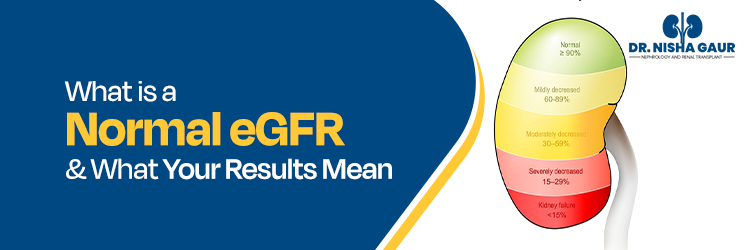
| eGFR | 90 or above is generally normal | Below 60 may suggest kidney disease; below 15 may indicate severe loss of function |
| Sodium | 135–145 mEq/L | An imbalance may reflect a fluid or electrolyte disturbance |
| Potassium | 3.5–5.0 mEq/L | High potassium can become serious and needs medical attention |
| uACR | Less than 30 mg/g | Above 30 mg/g may indicate kidney damage |
Normal ranges may vary slightly from lab to lab. Always compare your values with the reference range printed on your report.
How to Read a Kidney Function Test Report
Many patients focus on the first abnormal number they see. In practice, a KFT report is interpreted as a pattern rather than as a single result. A careful reading starts with filtration markers, then moves to waste products, electrolytes, and urine findings. That sequence often gives a clearer picture of what the report is actually showing.
- Step 1: Check Serum Creatinine
There are several indicators of renal function, but serum creatinine is used frequently. If numbers rise beyond the normal range, it suggests inefficient renal filtering.
Creatinine results must be interpreted properly. Factors like age, muscle mass, and medications can change its value.
- Step 2: Check eGFR
eGFR is a crucial evaluation metric because it gives a general idea of the kidneys’ ability to filter blood. An eGFR of 90 or more is seen as normal. There is a risk of kidney failure if eGFR is below 15.
- Step 3: Check Urea / BUN
Urea or BUN reflects the amount of nitrogen waste in the blood. When it is elevated, kidney dysfunction is one possible explanation.
However, the interpretation is not always simple. High BUN can also be seen with dehydration, a high-protein diet, bleeding in the digestive tract, or increased tissue breakdown. That is why doctors compare BUN with creatinine and the clinical picture.
- Step 4: Check Electrolytes
The kidneys are central to maintaining electrolyte balance. When kidney function changes, sodium and potassium levels may also shift.
Potassium deserves special attention. A high potassium level is something one should never dismiss. It can affect heart rhythm and may need urgent medical review.
- Step 5: Check Urine Albumin or uACR
Urine albumin and uACR help detect protein leakage in urine. This is often one of the earliest measurable signs of kidney damage, especially in diabetes and hypertension.
An uACR below 30 mg/g is generally considered normal. A result above 30 mg/g may point toward kidney disease and usually warrants repeat testing, correlation with blood reports, and medical consultation.
How to Understand Your KFT Report
Patients often find the report easier to understand when common result patterns are explained in plain terms. The examples below are not diagnoses, but they can help you understand why further medical advice may be needed.
| Report Finding | Possible Meaning | What To Do |
| Creatinine high + eGFR low | Kidney filtration may be reduced | Consult a nephrologist |
| eGFR normal + uACR high | Early kidney damage is possible | Repeat the urine test and consult a doctor |
| BUN high + creatinine normal | Dehydration or a diet-related issue may be contributing | A doctor’s review is needed |
| Potassium high | Can affect heart rhythm | Seek urgent medical advice |
KFT Test Cost in India and Jaipur
The cost of a KFT in India usually depends on the laboratory, the city, the number of parameters included, and whether home sample collection is requested. In routine listings, many providers show pricing in the range of about ₹399 to ₹700, although some packages may be higher.
KFT test cost in Jaipur may vary from lab to lab. If your report is abnormal, booking the test is only the first step; proper interpretation by a kidney specialist is more important. A report becomes useful only when the values are read in the context of symptoms, medical history, and repeat trends if needed.
Who Should Get a KFT Test?
A KFT is commonly advised for people who either have symptoms suggestive of kidney disease or belong to a higher-risk group.
- Diabetes patients.
- High blood pressure patients.
- People with swelling in the feet, face, or eyes.
- Foamy urine or blood in urine.
- Reduced urine output.
- Family history of kidney disease.
- Long-term painkiller use.
- Kidney stone patients.
- Before major surgery.
- People with heart disease.
Symptoms That May Require a Kidney Function Test
Kidney-related symptoms are not always critical. In fact, many of them are easy to overlook in the early stages, especially when they resemble general tiredness or fluid retention.
Symptoms like blood in urine, foamy urine, frequent urination, reduced urination, swelling, fatigue, nausea, and loss of appetite can be possible reasons for kidney function testing.
- Swelling in legs or face.
- Fatigue.
- Nausea or vomiting.
- Foamy urine.
- Blood in urine.
- Burning urination.
- Frequent urination at night.
- High blood pressure.
- Loss of appetite.
- Lower back or flank pain.
When Should You Consult the Best Nephrologist in Jaipur?
A single mildly abnormal result may sometimes need only repeat testing, but repeated abnormalities should be evaluated properly. You should consult the best nephrologist in Jaipur if:
- Creatinine is repeatedly high.
- eGFR is below normal.
- Protein or albumin is present in urine.
- Potassium is high.
- You have diabetes or high blood pressure with abnormal KFT.
- Swelling, foamy urine, or reduced urination continues.
- KFT values are worsening over time.
In case your KFT data is abnormal, consult Dr. Nisha Gaur, the best nephrologist in Jaipur, for a correct diagnosis.
KFT Test Preparation: Is Fasting Required?
Most KFTs do not need patients to fast. However, if the KFT is part of a broader package with some other blood examinations, then some doctors or laboratories may ask for fasting.
Before the test, tell your doctor about any medicines or supplements you are taking, including diabetes or blood pressure medicines.
KFT vs RFT: Are They the Same?
KFT stands for Kidney Function Test, while RFT stands for Renal Function Test. In day-to-day clinical use, both terms are commonly used for similar test panels.
The exact contents may differ slightly from one laboratory to another. One panel may include urine albumin, calcium, and phosphorus. Another may focus mainly on creatinine, urea, and electrolytes. For this reason, it is always useful to check which parameters are actually included in the report.
How Often Should You Get a KFT Test?
There is no single schedule that applies to everyone. The right testing interval depends on age, risk profile, and medical history.
In healthy adults, a KFT may be done as part of a routine checkup if advised. In people with diabetes, hypertension, chronic kidney disease, or those taking medicines that can affect the kidneys, testing is usually more regular and more clinically important.
| Person Type | Testing Frequency |
| Healthy adult | As part of a routine checkup, if advised |
| Diabetes patient | Usually yearly or as advised |
| High BP patient | Regularly as advised |
| CKD patient | More frequent monitoring |
| On kidney-affecting medicines | As per the doctor’s advice |
Regular kidney checks must be done for people with diabetes, high blood pressure, heart disease, or a family history of kidney failure.
FAQs About KFT Test
1. What is the full form of the KFT test?
KFT means Kidney Function Test. It is a set of blood and urine checks doctors use to see how well your kidneys are working. Think of it as a report on filtration, waste clearance, fluid balance, and electrolyte levels.
2. What is the normal creatinine range in KFT?
There’s no single fixed number, and doctors factor in age, sex, body build, hydration, and muscle mass before drawing conclusions. As a rough guide, men typically fall somewhere between 0.74 and 1.35 mg/dL, while women usually range from 0.59 to 1.04 mg/dL.
3. What eGFR level is normal?
eGFR gives an estimate of how efficiently your kidneys are filtering blood. Generally speaking, 90 or above is a good sign, provided everything is normal. Once it drops below 60, that’s usually a signal for further evaluation, particularly if a repeat test shows the same low reading. Doctors usually don’t look at eGFR in isolation, though; it’s always weighed against creatinine, urine results, your age, and your broader health picture.
4. Is the KFT test done on an empty stomach?
Not necessarily. A lot of KFT panels don’t require fasting at all. That said, if it’s bundled with sugar or lipid testing as part of a bigger package, your lab or doctor might ask you to fast beforehand. The safest option is to follow the instructions that came with your prescription or booking.
5. What is the cost of a KFT test in Jaipur?
Pricing depending on which lab you choose, how many parameters are being checked, and whether you want someone to come collect your sample at home. Roughly speaking, can expect the cost somewhere between ₹399 and ₹700, though this may differ according to which diagnostic centre you choose. It is worth checking what’s included before booking; a lower price sometimes skips the urine test or leaves out reporting support altogether.
6. When should I consult a nephrologist after KFT?
If your creatinine keeps coming back high, your eGFR is on the lower side, there’s protein or albumin showing up in urine, or potassium is out of range, that’s when it’s time to see a nephrologist. If you’re noticing swelling, foamy urine, or blood pressure that doesn’t get into the normal range, you should also ask for a consultation. For anyone managing diabetes or hypertension, an abnormal report isn’t something to ignore. Getting it checked early can make a difference down the line.
7. Can KFT detect kidney failure?
A KFT can certainly raise red flags and hint at serious kidney trouble. Sharply elevated creatinine, low eGFR, electrolyte imbalances, or protein turning up in urine, all of these point toward significant loss of function. But no doctor calls it kidney failure based on one report alone. It takes a fuller picture: repeat tests, urine analysis, imaging, medical background, and symptoms all considered together before anything gets confirmed.

2 comments